
Morgens der Blick in den Spiegel, dann auf die Haarbürste – wann ist das normal, wann ein Warnsignal? Bis zu 100 Haare täglich zu verlieren gilt medizinisch als unbedenklich. Der Körper erneuert sich ständig, Haare fallen aus und wachsen nach.
Ein ausgefallenes Haar mit einer kleinen weißen Verdickung am Ende hat seinen natürlichen Zyklus beendet. Fehlt diese Verdickung, handelt es sich meist um Haarbruch durch mechanische Einwirkung, nicht um Ausfall an der Wurzel.
Fachleute unterscheiden zwei grundlegende Formen. Beim vorübergehenden, oft stressbedingten Ausfall – medizinisch Telogenes Effluvium – wächst das Haar meist wieder nach. Beim dauerhaften Haarverlust (Alopezie) wird das Haar mit jedem Zyklus feiner und kürzer, ohne sich vollständig zu erholen.
Das eigentliche Warnsignal ist selten das einzelne Haar auf dem Kopfkissen. Auffälliger ist ein schleichender Verlust an Volumen: ein breiter werdender Scheitel im Badezimmerlicht oder ein spürbar dünner werdender Pferdeschwanz.
Der Wachstumsrhythmus: Warum jedes Haar seinen eigenen Takt hat
Dass bis zu 100 Haare täglich ausfallen können, klingt viel – ist aber normal, weil jedes Haar einem eigenen Zyklus folgt. Die Haarpapille tief in der Kopfhaut steuert, wann ein Haar wächst, pausiert oder ausfällt.
Dieser Zyklus lässt sich in drei Phasen unterteilen:
- Growth Phase (Anagen Phase): Etwa 85 bis 90 Prozent der Haare befinden sich aktuell hier. Sie dauert zwei bis sechs Jahre.
- Transitional phase (catagen phase): Das Haar löst sich von seiner Nährstoffversorgung, das Wachstum stoppt. Diese Phase dauert nur wenige Wochen.
- Resting phase (telogen phase): Das Haar verbleibt noch zwei bis vier Monate in der Kopfhaut, bevor es ausfällt und Platz für ein neues macht.
Starker Stress oder Krankheiten können viele Follikel gleichzeitig vorzeitig in die Telogenphase drängen. Da diese Phase Monate dauert, zeigt sich der Ausfall oft erst deutlich später – ein stressiges Ereignis im März kann im Sommer sichtbar werden. Das ist bei der Ursachensuche ein wichtiger Hinweis.

Interpreting a receding hairline correctly: When the hairline turns into a ‚V‘
Häufig zeigt sich die erste Veränderung an den Schläfen: Die Haarlinie weicht zurück. Beim erblich bedingten Haarausfall (Androgenetische Alopezie) folgt dieser Rückzug einem klaren Muster. Die Follikel an Stirn und Schläfen reagieren genetisch bedingt empfindlich auf bestimmte körpereigene Hormone. Beim diffusen Haarausfall hingegen dünnt der gesamte Kopf gleichmäßig aus.
Dieser Prozess passiert schrittweise. Das Haar verschwindet nicht plötzlich, sondern wird mit jedem Zyklus feiner und kürzer – man nennt das Miniaturisierung. Um eine natürlich reifende Haarlinie von beginnendem Haarausfall zu unterscheiden, helfen folgende Punkte:
- Diameter: Do the front hairs feel noticeably thinner than the hairs on the back of your head?
- Pigmentation Werden die Haare am Ansatz heller und ähneln einem feinen Flaum?
- Density: Scheint die Kopfhaut am Haaransatz unter einer hellen Lampe deutlicher durch?
Dermatologen nutzen zur Einstufung dieses Musters die Norwood-Skala. Sie hilft, den aktuellen Haarstatus objektiv mit früheren Fotos zu vergleichen. Ein leichtes Zurückweichen der Haarlinie ist oft eine altersbedingte Veränderung. Tiefere Einbuchtungen können auf geschwächte Follikel hinweisen. Bei Frauen verläuft dieser Prozess häufig unauffälliger.
Receding hairlines in women: Why hair loss often starts here without being noticed
Manchmal fällt es zuerst beim Binden des Pferdeschwanzes auf: Der Zopfgummi braucht plötzlich eine Runde mehr. Beim erblich bedingten Hair Loss in Women zeigen sich selten kahle Schläfen oder eine zurückweichende Stirnlinie. Stattdessen reagieren die Follikel am Oberkopf auf hormonelle Schwankungen. Die Haare werden mit jedem Zyklus feiner und kürzer, bis das Gesamtvolumen spürbar nachlässt.
Ein Blick von oben auf den Mittelscheitel verrät oft mehr als die reine Haarmenge. Mediziner sprechen vom Tannenbaummuster: Der Scheitel ist vorne breiter und wird nach hinten schmaler. Zur Einordnung dient die Ludwig-Skala, die den weiblichen Haarverlust in Schweregrade einteilt. Mit einem einfachen Check lässt sich das Muster selbst beurteilen:
- Part in the middle Nasses Haar mit einem Stielkamm genau in der Mitte teilen.
- Use a light source: Unter eine helle Lampe stellen.
- Breite prüfen: Im Spiegel schauen, ob die Kopfhaut vorne stärker durchscheint als am Hinterkopf.
Nicht jede lichter werdende Frisur folgt diesem genetisch bedingten Muster. Wenn die Haare gleichmäßig über den gesamten Kopf ausfallen, liegen die Ursachen meist woanders.
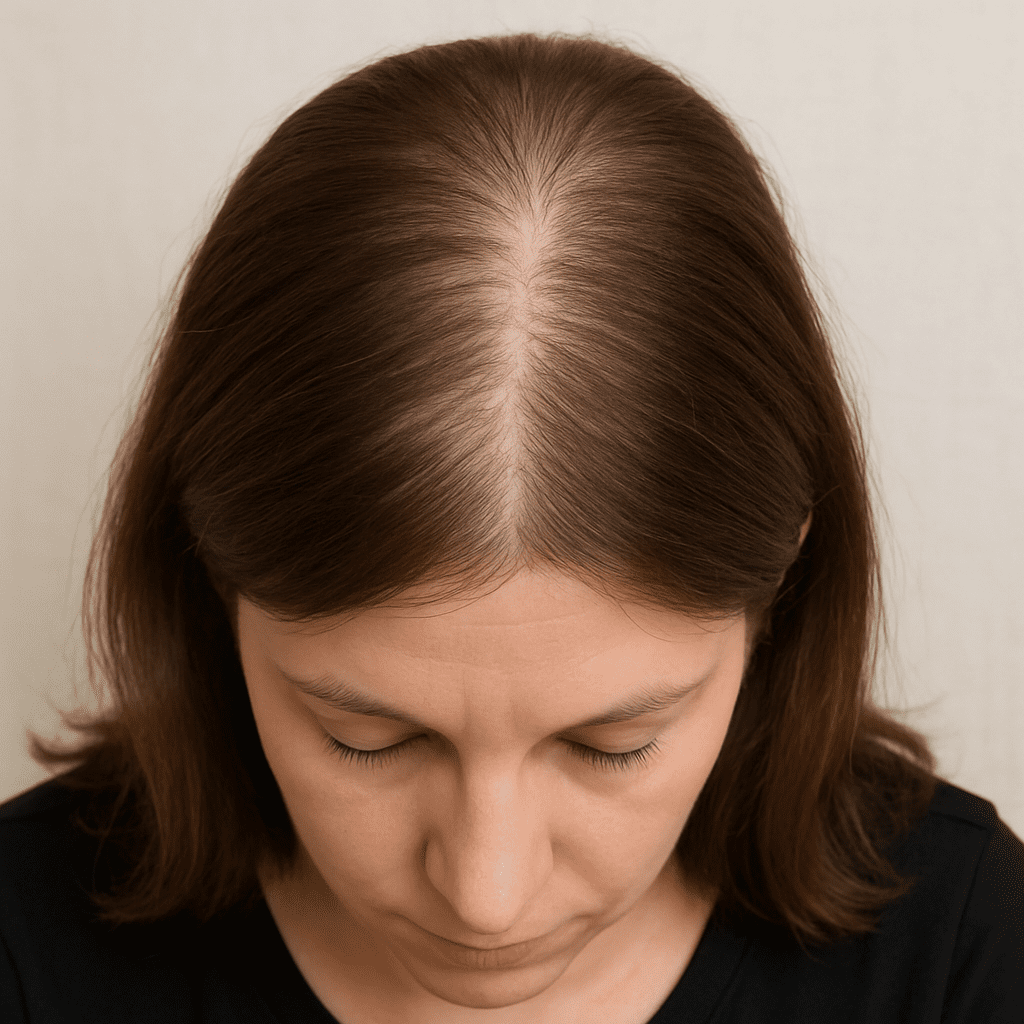
Diffuse Hair Loss Due to Stress and Nutrient Deficiency: When Volume Disappears All Over the Head
Sometimes a disturbing picture emerges: Hair isn’t just missing in one spot; the entire head of hair noticeably loses its density. This uniform thinning differs significantly from the hereditary patterns seen at the part. When the body is exposed to extreme stress, clear symptoms of sudden hair loss due to stress often appear. In times of crisis, the body essentially pulls the emergency brake and abruptly stops hair growth in order to conserve valuable energy for more vital bodily functions.
Medical professionals refer to this phenomenon as diffuse hair loss. Understanding the telogen phase helps us grasp the causes and characteristics of telogen effluvium. Normally, only a small portion of the hair is in the resting phase at any given time. However, in the event of physical shock or severe stress, an unusually large number of follicles are forced prematurely into this shedding phase. Much like a tree that suddenly sheds its leaves in the fall, the hair then falls out in large quantities several months after the trigger.
Look closely at a peculiar hair against a light source. Do you notice a small, bright nodule at the root? This is a so-called club hair, a sign of regularly ended hair growth. If these club hairs appear in large numbers, the body often simply lacks strength. Insufficient nutrition noticeably weakens the follicles. During such phases, targeted vitamins for brittle hair and hair loss can help to strengthen the roots from within.
Fortunately, this diffuse hair loss is usually only a temporary problem. Once the nutrient deficiency is resolved or stress levels have decreased, the follicles resume their normal function. Hair volume then usually returns on its own.
Alopecia Areata: Recognizing the Early Signs in Time
Sometimes it happens practically overnight: while combing your hair or taking a shower, you suddenly notice a completely bald, coin-sized patch. Unlike gradual thinning, the patchy hair loss typical of alopecia areata is sharply defined and occurs extremely abruptly. Doctors refer to this as circular hair loss. This phenomenon is often unpredictable for those affected. The body’s own immune system mistakenly attacks healthy hair follicles and abruptly stops hair growth.
To distinguish this form from other causes, a closer look at the affected areas helps. Look for early signs of circular hair loss, which are characterized by the following typical features:
- Form and size: The holes are usually circular or oval in shape.
- Skin type: The scalp at the affected area looks completely normal, smooth, and healthy.
- The hairline At the edges of the bald spots, you often find a few millimeters of short, broken stubble.
These short hairs on the edge are an important diagnostic tool for dermatologists. When examined closely in the light, they become thinner towards the scalp. The upper end of the hair, on the other hand, is significantly thicker. Because of this distinctive optical shape, they are also called exclamation mark hairs in practice. They indicate that hair loss in this area is still acute and active.
Itching, redness, flaking: Scalp warning signs you shouldn't ignore
We all know what it's like to occasionally scratch our heads, especially in dry winter air. However, if this feeling turns into a persistent burning sensation, caution is advised. A quick check often reveals more than just harmless, white flakes of skin. If you discover greasy, yellowish scales on reddened skin, this indicates an acute inflammation. Dermatologists refer to this phenomenon as seborrheic eczema. This chronic irritation of the skin barrier is one of the often overlooked causes of hair loss.
Imagine your scalp as the soil for a plant. If the soil is inflamed, the root inevitably suffers. The released inflammatory substances force the hair follicles prematurely into their resting phase. The result is inflammatory hair loss, where the hair literally loses its grip. A fatal mistake here is the natural reflex to give in to the intense itching. Constant scratching damages the sensitive barrier, making it easier for bacteria to penetrate. This mechanical friction greatly accelerates the problem. This also explains the common connection between an itchy scalp and thinning hair.
Visible redness and a noticeable burning sensation are clear indicators of the quality of this growth medium. A healthy scalp is absolutely essential to stop further thinning of the hair. Hair growth often normalizes once the underlying inflammation is medically treated.
The 3-Step At-Home Self-Test: How to Objectively Assess Your Hair Loss
A clogged shower drain can quickly cause panic in the morning. However, the mere feeling when combing often deceives. The first and most important question is therefore: How much hair loss per day is normal? Dermatologists set the healthy limit at about 100 hairs. To reliably check this number, collect and count all shed hairs over three consecutive days. This will create an initial, objective data foundation.
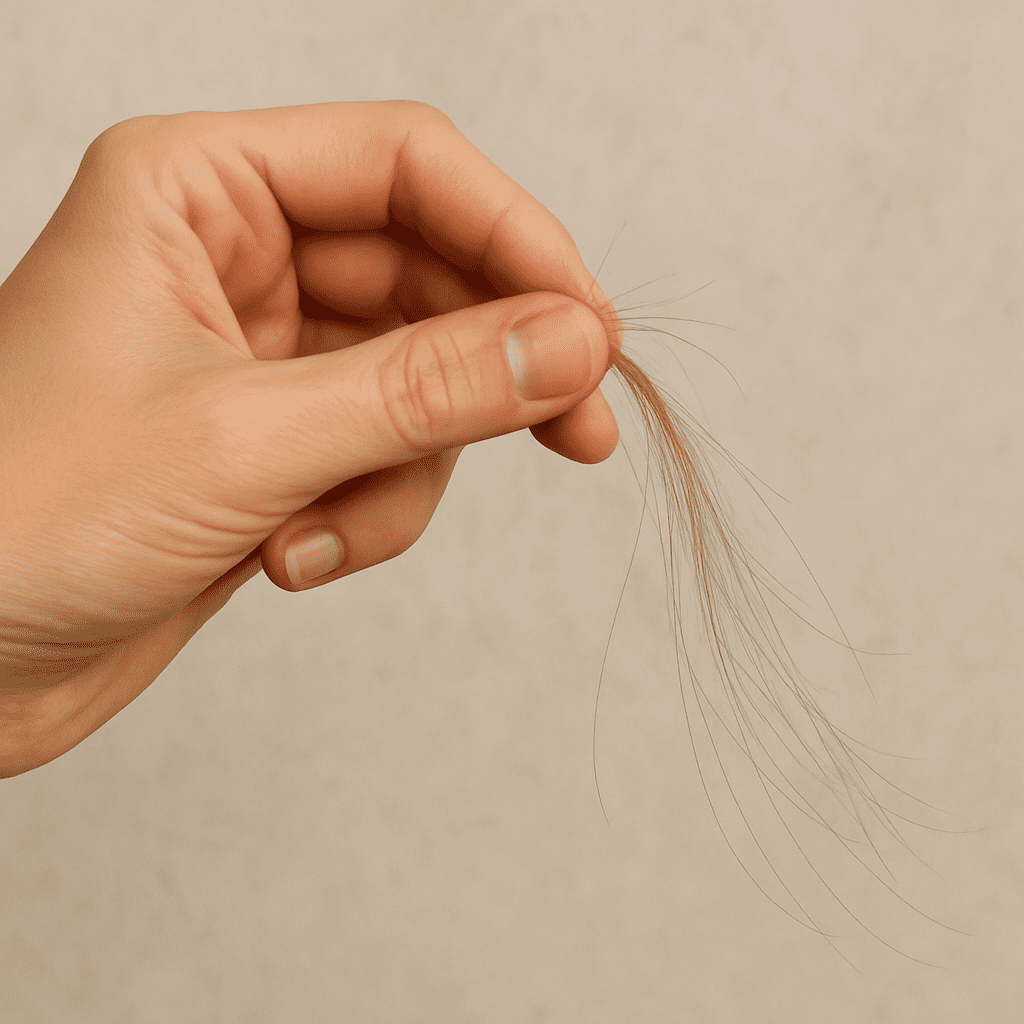
Once you know your approximate shedding rate, the mechanical check follows. With the so-called pull test (also called the epilation test), you directly examine how firmly the roots are anchored in the scalp. This simple grip immediately shows you whether too many follicles are already in the loose detachment phase. Proceed gently and absolutely painlessly when performing it:
- Step 1: Grasp a small bunch of about 60 hairs near the scalp.
- Step 2: With gentle but steady pressure, draw from the roots to the tips.
- Step 3: Repeat this process in three different places on your head.
- Step 4: If you hold more than six hairs in your fingers per bundle, the test is considered conspicuous.
Besides plucking, long-term visual documentation is your strongest tool. If you want to check your hair density at home yourself, make sure to keep a photo diary. Take photos of your parting or hairline every four weeks with exactly the same camera light. This way, you can replace creeping anxieties with hard facts and recognize real changes in hair mass.
The hair root test at the dermatologist: What to expect from the professional diagnosis
Once home tests reach their limits, a professional examination provides certainty. The process of a hair root test with a dermatologist usually begins completely painlessly today with a digital magnifying glass. This method is called trichoscopy (epiluminescence microscopy). The doctor examines your scalp under high magnification on a high-resolution screen. This allows them to immediately see if your hair follicles are intact or are already visibly thinning.
Sometimes even deeper analysis is needed to clarify complex causes of hair loss. This is where the classic trichogram (hair root examination) comes into play. The dermatologist carefully takes a small tuft of hair and examines the roots under a microscope. Similar to looking into garden soil, the doctor can see which hairs are growing and which are resting. This ratio precisely shows whether your natural hair cycle has been disrupted.
However, the key to healthy growth often lies not on the scalp, but in the blood. An internal nutrient deficiency literally starves the hair, which is why medical laboratory values are crucial. The ferritin level (iron stores) is particularly important, as iron supplies oxygen to the hair follicles. When being diagnosed, ask your doctor to check the following parameters:
- Ferritin Ensures vital oxygen supply to the hair roots.
- TSH level Checks for an undetected thyroid disorder.
- Zinc An essential building block for healthy hair growth.
- Biotin Supports the development of a strong hair structure.
When all these diagnostic puzzle pieces are in place, you can act with confidence together with the doctor.
Your Personal Roadmap: From Symptom to Targeted Treatment
You now know exactly how to distinguish real symptoms of hair loss from natural hair shedding. Instead of just paying attention to the amount of hair falling out, you can now recognize the true warning signs: you check for thinning hair at the temples, a widening part, or an itchy scalp. This knowledge turns uncertain guesswork into targeted observation.
Use these findings for a structured approach. Start immediately by objectively documenting your observations. Take weekly photos under the same bright lighting conditions in your bathroom. Once your suspicion is confirmed and the thinning areas become more visible, the next step is to see a specialist. A dermatologist can professionally diagnose the exact causes and provide personalized treatment.
On this path, patience will be your most important companion. The natural hair cycle reacts very slowly to therapeutic changes. Do not expect quick miracles, but focus on the realistic goal: stabilizing your current hair condition. Every hair loss that is recognized and treated in time significantly increases the chances of stopping the process. With your new understanding of your body's signals, you have laid the foundation. Early detection remains the crucial key to your success.
