
A Anemia (umgangssprachlich Blutarmut) gilt in der Medizin meist nicht als eigenständige Krankheit, sondern als Hinweis darauf, dass in der Blutbildung oder beim Blutverlust etwas nicht stimmt.

In Germany, the most common form of anemia is iron deficiency anemia. Symptoms can include fatigue, weakness, headaches, dizziness, shortness of breath, and pale skin. In severe cases, it can lead to heart problems.
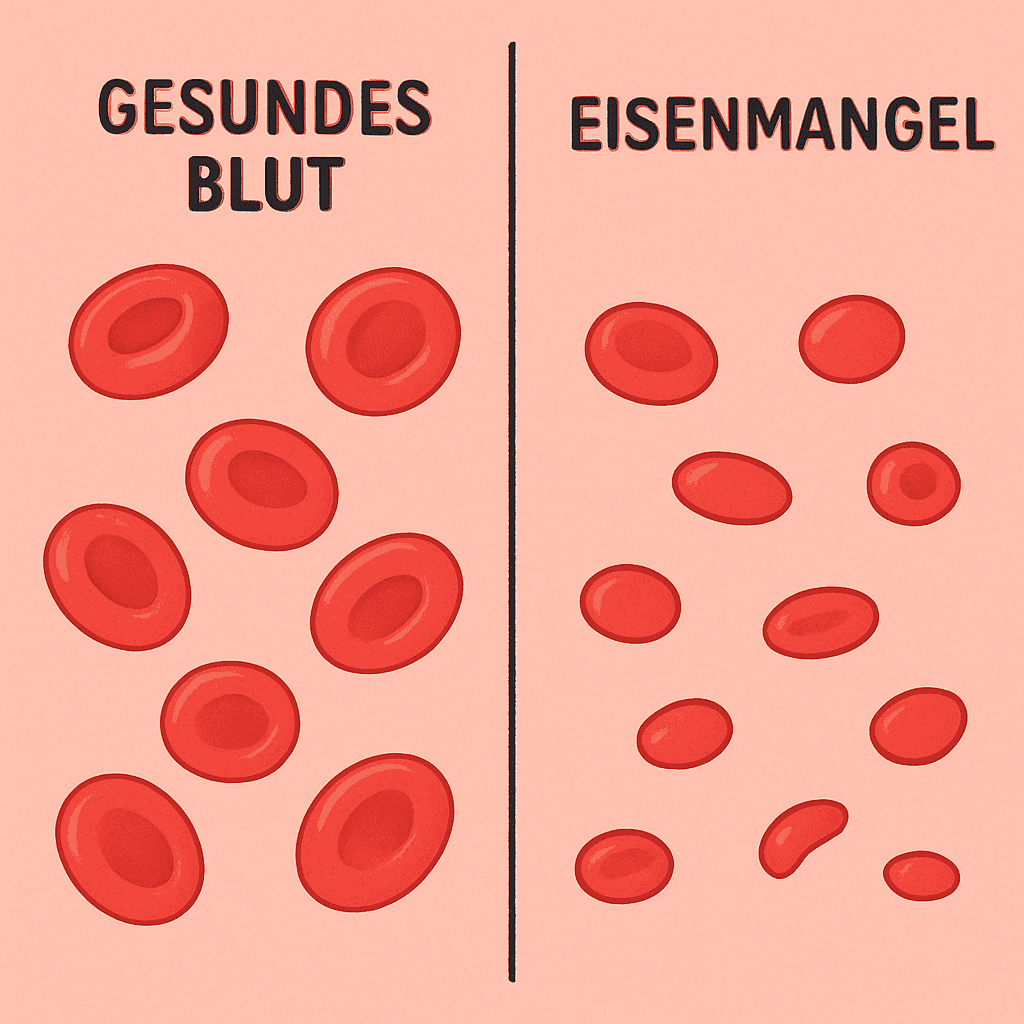
Rote Blutkörperchen (Erythrozyten) transportieren Sauerstoff von der Lunge zu den Organen. Der eigentliche Träger ist das Hämoglobin, der rote Blutfarbstoff. Liegt der Hämoglobinwert zu niedrig, hat das Blut nicht mehr ausreichend Transportkapazität. Organe und Muskeln werden schlechter mit Sauerstoff versorgt.
Typische Anämie-Symptome
Die Beschwerden entwickeln sich oft schleichend. Da der Körper lebenswichtige Organe wie Herz und Gehirn bevorzugt versorgt, wird die Haut früh weniger durchblutet – daher die typische Blässe.
Weitere häufige Beschwerden:
- Exhaustion Anhaltende Kraftlosigkeit.
- Headaches and dizziness Especially when standing up quickly.
- Cold hands and feet Durch verminderte Durchblutung der Extremitäten.
- Atemnot bei Belastung: Schon beim Treppensteigen kann Luftnot auftreten. Das Herz schlägt schneller, um das Sauerstoffdefizit auszugleichen.
Eisenmangel und Blutarmut – wo liegt der Unterschied?
Die Begriffe werden oft gleichgesetzt, sind aber nicht dasselbe. Eisen ist der Baustoff, Hämoglobin das Endprodukt. Bei einem latenten Eisenmangel sind die Speicher geleert, die Blutbildung funktioniert aber noch. Erst wenn der Körper kein neues Hämoglobin mehr bilden kann, entsteht eine manifeste Anämie.
Neben den allgemeinen Anämie-Symptomen können bei einer Eisenmangelanämie zusätzliche Zeichen auftreten:
- Cracked corners of the mouth (rhagades)
- Brittle, grooved fingernails
- Hair loss
- Brennendes Gefühl auf der Zunge
Welche Ursachen stecken hinter einer Blutarmut?
Da die Anämie meist ein Symptom ist, stellt sich die Frage nach der Grundursache. Diese lässt sich grob in drei Kategorien einteilen: Blutverlust, verminderte Blutbildung und gesteigerter Blutabbau.
Chronic blood loss
Bei Frauen im gebärfähigen Alter ist eine starke Menstruation der häufigste Grund. Bei Männern und Frauen nach den Wechseljahren sollte an versteckte innere Blutungen gedacht werden – etwa durch Magengeschwüre, chronisch entzündliche Darmerkrankungen oder Tumore im Magen-Darm-Trakt. Da diese Blutungen oft mikroskopisch klein sind, bleiben sie lange unbemerkt.
2. Inflammation and Infections
Bei chronischen Entzündungen wie Rheuma schüttet das Immunsystem Botenstoffe aus, die das vorhandene Eisen in den Speichern blockieren. Es steht dann nicht mehr für die Blutbildung zur Verfügung – obwohl eigentlich genug vorhanden wäre. Diesen Zustand nennt man Anämie bei chronischen Erkrankungen.
3. Perniziöse Anämie und Vitamin-B12-Mangel
The Pernicious anemia ist eine Autoimmunerkrankung, bei der der Körper Zellen der Magenschleimhaut angreift. Diese Zellen produzieren den sogenannten Intrinsic Factor, der für die Aufnahme von Vitamin B12 im Darm notwendig ist. Fehlt Vitamin B12, ist die Zellteilung gestört – und damit auch die Bildung roter Blutkörperchen.
Ein ausgeprägter Vitamin-B12-Mangel betrifft häufig auch das Nervensystem:
- Tingling or numbness in hands and feet
- Gun security concerns
- Memory problems and depressive moods
- Auffällig glatte, rote Zunge („Lackzunge“)
Diagnose beim Arzt
Bei Verdacht auf eine Blutarmut ist eine ärztliche Abklärung notwendig – nicht nur um die Anämie zu bestätigen, sondern vor allem um die Ursache zu finden. Der erste Schritt ist eine Blutentnahme.
Die wichtigsten Werte im Blutbild:
- Red Blood Cells (RBC) Anzahl der roten Blutkörperchen.
- Hemoglobin (Hb): Der zentrale Wert für die Diagnose. Die WHO spricht von Blutarmut, wenn er bei Frauen unter 12 g/dl und bei Männern unter 13 g/dl liegt.
- Hematocrit (Hct) Anteil der zellulären Bestandteile am Blutvolumen.
- MCV and MCH: Zeigen Größe und Hämoglobingehalt der roten Blutkörperchen. Kleine, blasse Zellen deuten auf Eisenmangel hin; sehr große Zellen eher auf einen Vitamin-B12- oder Folsäuremangel.
Zusätzlich prüft der Arzt den Eisenstoffwechsel. Ein wichtiger Marker ist das Ferritin (Speichereisen). Normalwerte liegen bei Frauen zwischen 15 und 150 µg/l, bei Männern zwischen 30 und 400 µg/l. Werte unter 15 µg/l zeigen entleerte Eisenspeicher an. Bei Entzündungen kann der Ferritinwert jedoch normal oder erhöht wirken, weshalb oft weitere Werte wie CRP und Transferrinsättigung bestimmt werden.

Treatment and Self-Help: What You Can Do
Therapy is always guided by the underlying cause. Uncontrolled intake of supplements based on suspicion is not advisable, as too much iron can harm the body.
The Power of the Meal Plan
is a mild iron deficiency the cause, can a Dietary changes to increase iron absorption to be the first and most important step. There are a few biochemical tricks to consider: Heme iron (e.g., in red meat, liver) found in animal products can be very well utilized by the human intestine. Non-heme iron from plants (in oatmeal, lentils, spinach, pumpkin seeds), on the other hand, is absorbed less effectively.
Actionable Tip for Iron Absorption: Combine plant-based iron sources always with vitamin C. A glass of orange juice with oatmeal or fresh bell peppers in lentil stew can significantly increase iron absorption in the gut. At the same time, avoid inhibitors such as black tea, coffee, or calcium-rich dairy products directly with meals.
When tablets are not enough
In cases of manifest deficiency, the doctor will typically prescribe high-dose iron tablets. These often need to be taken for three to six months to sustainably fill the stores. A well-known problem with this is side effects such as abdominal pain, nausea, or constipation.
However Iron infusions are medically necessary when a person has severe iron deficiency anemia that cannot be effectively treated with oral iron supplements. This can occur due to: * **Malabsorption issues:** Conditions like celiac disease, inflammatory bowel disease (Crohn's or ulcerative colitis), or gastric bypass surgery can impair the body's ability to absorb iron from food or oral supplements. * **Chronic blood loss:** Conditions causing ongoing blood loss, such as heavy menstrual bleeding, gastrointestinal bleeding (from ulcers, polyps, or cancer), or frequent blood donation, can deplete iron stores faster than they can be replenished orally. * **Intolerance to oral iron:** Some individuals experience significant gastrointestinal side effects (nausea, constipation, diarrhea) from oral iron supplements that prevent them from taking them consistently or at a sufficient dose. * **Rapid iron repletion needed:** In certain situations, such as before major surgery or in critically ill patients, a rapid increase in iron levels is required, which can be achieved more quickly with intravenous iron. * **Specific medical conditions:** Certain chronic diseases, like chronic kidney disease (especially in patients on dialysis), heart failure, or cancer, can be associated with iron deficiency and may benefit from iron infusions. A healthcare professional will determine if an iron infusion is the appropriate treatment based on a patient's medical history, symptoms, and laboratory test results (e.g., hemoglobin, ferritin, transferrin saturation).Infusions where iron is administered directly into a vein are used when:
- The patient absolutely cannot tolerate iron tablets due to severe gastrointestinal side effects.
- There is an absorption problem (the intestine cannot absorb the iron at all, e.g., in chronic intestinal diseases such as Crohn's disease).
- The deficiency is so severe or the blood loss occurs so rapidly that immediate replenishment of stores is vital (for example, in preparation for major surgery or in advanced heart failure).
In cases of diagnosed vitamin B12 deficiency, especially in the context of pernicious anemia, tablets are often ineffective because the stomach cannot process the active ingredient. In such cases, vitamin B12 is usually administered directly into the muscle in the form of injections – initially weekly, and later for maintenance therapy every few months, often for life.
Conclusion: Listen to your body's signals
Consider the Anemia as a symptom and not as a final diagnosis. If you suffer from unexplained fatigue, decreased performance, or constant cold, this is not weakness, but a physiological reality that should be investigated.
Whether it's a simple iron deficiency anemia due to poor diet, pernicious anemia, or an undiagnosed chronic inflammation weakening the body – a simple blood test at the doctor's office quickly brings clarity. With the correct diagnosis, the cause can be excellently treated in most cases, allowing energy and quality of life to return noticeably after a short time. Take charge of your health and have persistent fatigue medically clarified!
Quellen
