
Stundenlang wach liegen, während der Kopf nicht zur Ruhe kommt – das kennen viele. Eine vorübergehende Schlafstörung in Stressphasen ist normal. Wenn die Nächte aber dauerhaft schlecht werden, lohnt es sich, genauer hinzuschauen.
Schlaflosigkeit wird oft als isoliertes Problem behandelt. Häufig ist sie aber eher ein Hinweis auf etwas anderes – ein Symptom, keine eigenständige Erkrankung. Den Unterschied zu erkennen ist der erste Schritt.
Eine unruhige Woche vor einer großen Präsentation ist eine normale Reaktion. Bleibt die Erholung aber über Monate aus, können tieferliegende Ursachen dahinterstecken – von Schilddrüsenproblemen bis zu emotionalen Belastungen.
Primäre vs. sekundäre Insomnie: Ist der Schlaf das Problem oder ein Symptom?
Bei der primären Insomnie ist der fehlende Schlaf selbst das Hauptproblem – ohne erkennbare körperliche oder seelische Auslöser. Das Gehirn hat schlichtweg verlernt abzuschalten.
Häufiger ist die sekundäre Form: Die durchwachten Nächte sind Symptom, die eigentliche Ursache liegt woanders – von Alltagsstress bis zu organischen Erkrankungen. Hier hilft es nicht, das Symptom zu behandeln, ohne die Ursache zu kennen.
Wenn Hormone den Schlaf stören: Schilddrüse und Wechseljahre
Hormone steuern direkt den Schlaf-Wach-Rhythmus. Eine unerkannte Schilddrüsenüberfunktion oder die beginnenden Wechseljahre können dazu führen, dass der Körper mitten in der Nacht falsche Wachsignale sendet.
Besonders der Einfluss von Hormonschwankungen auf den Schlaf wird oft unterschätzt. Typische Hinweise, dass nicht die Matratze, sondern der Hormonhaushalt das Problem ist:
- Nachtschweiß (plötzliche Hitzewallungen im Schlaf)
- Herzrasen ohne körperliche Anstrengung
- Regelmäßiges Aufwachen zur selben Uhrzeit
- Innere Unruhe und ein Gefühl dauernder Anspannung
Treffen mehrere dieser Punkte zu, ist ein Arztbesuch sinnvoll. Ein Blutbild beim Hausarzt, Gynäkologen oder Endokrinologen kann klären, ob ein Ungleichgewicht der Schilddrüsen- oder Geschlechtshormone vorliegt.
Chronischer Stress und Cortisol: Warum das Gehirn nicht abschaltet
Körperlich erschöpft, aber gedanklich hellwach – das ist kein Defekt, sondern ein altes Schutzmuster. Wer tagsüber unter Dauerdruck steht, hält das Nervensystem in einem Zustand dauerhafter Alarmbereitschaft.
Die sogenannte Stressachse (HPA-Achse) schüttet bei anhaltendem Stress kontinuierlich Cortisol aus. Cortisol und Melatonin sind biochemische Gegenspieler: Bleibt das Cortisol abends erhöht, wird die Melatoninproduktion gehemmt – der Schlaf bleibt aus.
Um diesen Kreislauf zu unterbrechen, muss das Nervensystem vor dem Schlafen aktiv beruhigt werden. Gelingt das nicht, kommen oft weitere Faktoren hinzu.
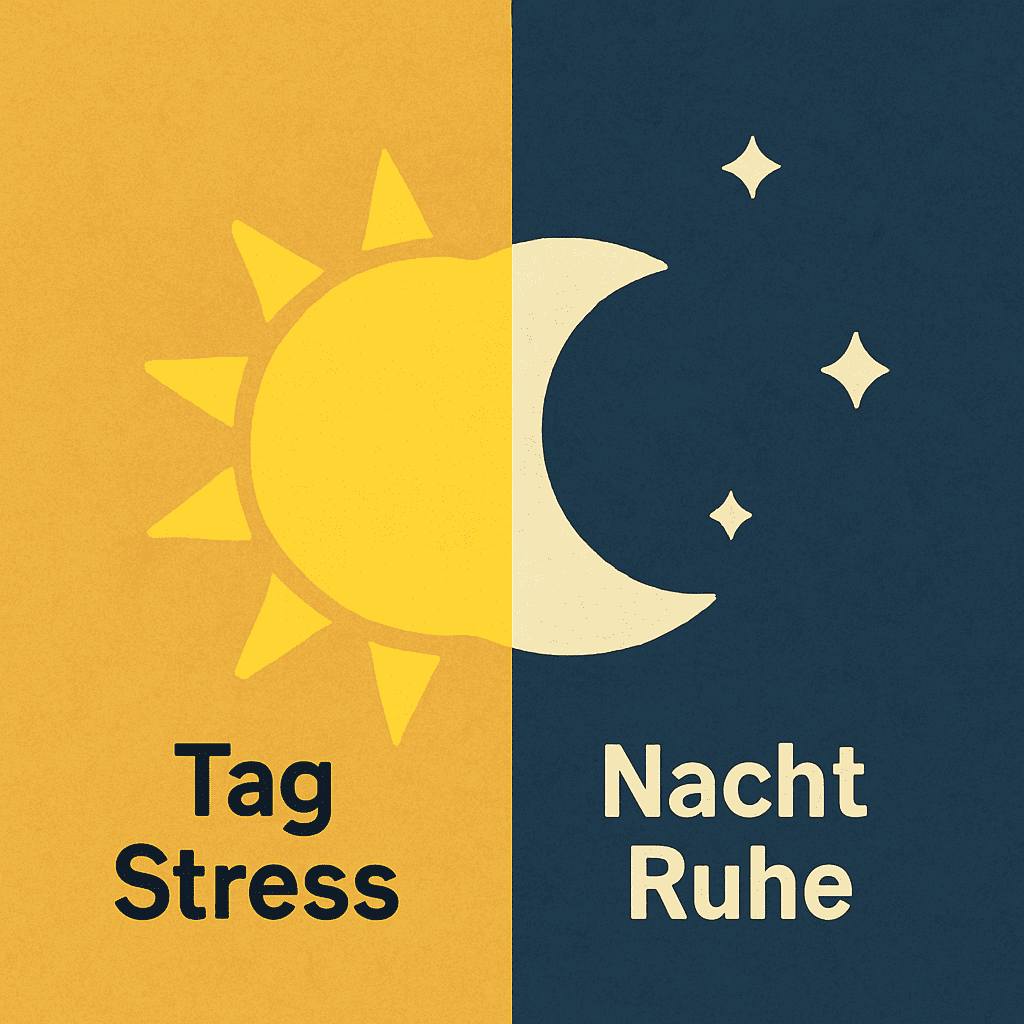
Warum wache ich immer um 3 Uhr auf? Serotonin und die innere Uhr
Wer nachts immer zur gleichen Zeit aufwacht, erlebt das nicht zufällig. Das Gehirn wandelt abends Serotonin in Melatonin um. Wer tagsüber durch chronischen Stress Serotoninreserven abbaut, hat nachts weniger Melatonin zur Verfügung. Gegen drei Uhr morgens sinkt der Melatoninspiegel ohnehin leicht ab – fehlt die biochemische Basis, reicht das zum Aufwachen.
Zusätzlich arbeitet die Leber zwischen 1 und 3 Uhr nachts besonders intensiv. Ist sie durch spätes Essen, Alkohol oder Dauerstress belastet, kann das eine innere Unruhe erzeugen, die den Schlaf unterbricht.
Wer abends leicht isst und beim nächtlichen Erwachen den Blick auf die Uhr vermeidet, nimmt dem Gehirn einen möglichen Auslöser für einen erneuten Cortisolanstieg.
Eisenmangel und unruhige Beine
Manchmal ist der Kopf müde, aber die Beine lassen keine Ruhe. Das Restless-Legs-Syndrom (RLS) wird als Schlafursache oft übersehen. Hinter dem Bewegungsdrang steckt häufig ein Eisenmangel: Das Gehirn braucht Eisen, um Dopamin zu bilden – den Botenstoff, der Muskeln beruhigt.
Typische RLS-Hinweise:
- Kribbeln, Ziehen oder Brennen in den Unterschenkeln
- Bewegungsdrang, der abends oder nachts auftritt
- Beschwerden, die sich bei Ruhe verschlimmern
- Linderung durch Aufstehen und Bewegen
Ein normales Blutbild reicht hier oft nicht aus. Sinnvoll ist die gezielte Messung des Ferritinwerts (Speichereisen) – auch wenn die übrigen Eisenwerte unauffällig sind.
Schnarchen und Atemaussetzer: Wenn der Schlaf krankmacht
Nicht jedes Schnarchen ist harmlos. Bei der obstruktiven Schlafapnoe entspannt sich die Rachenmuskulatur so stark, dass die Atemwege vorübergehend blockiert werden. Der sinkende Sauerstoffgehalt weckt das Gehirn kurz auf – das passiert oft viele Male pro Nacht, ohne dass Betroffene es bewusst wahrnehmen.
Diese Mikrowachzustände verhindern den Tiefschlaf und belasten langfristig das Herz-Kreislauf-System. Zur Diagnose kann ein Schlaflabor eingesetzt werden, wo per Polysomnographie Hirnströme, Atmung und Herzschlag aufgezeichnet werden.
Steht die Diagnose, helfen oft Atemmasken oder veränderte Schlafpositionen. Neben körperlichen Ursachen kann aber auch die Psyche eine entscheidende Rolle spielen.
Soul Under Stress: Sleep Disorders as a Companion to Mental Illnesses
While with sleep apnea the body gasps for air, something completely invisible often robs us of our rest. The condition where physical exhaustion is overlaid by a brain running at full speed is particularly insidious. Often, it's not the body, but our own psyche that is the real trigger for sleepless hours.
Let's not consider sleeplessness here as an independent defect, but as a warning light from our inner engine. Especially with depression or anxiety disorders, lack of sleep often occurs as a classic accompanying symptom of mental illnesses. It is rather the visible symptom of a soul that is under massive pressure and seeking relief.
A central problem is so-called rumination, which robs us of mental control at night. Anyone who wonders what truly helps against nocturnal thought loops and rumination must understand that stress puts the mind in a state of constant alarm. The brain simply refuses to switch off because it mistakenly classifies unresolved emotional conflicts as an acute threat.
This quickly creates a dangerous vicious cycle, which experts call bidirectional causality – a mutual interaction. Psychological stress severely disrupts sleep, while the resulting lack of sleep exacerbates anxiety and depressive moods the next day. The mind and sleep thus drive each other into a stressful downward spiral.
However, this realization can be enormously relieving: your insomnia during such phases is not a personal failure, but a perfectly logical reaction to emotional overload. To successfully break this cycle and find the true cause together with a doctor, the next step requires reliable data from your bedroom.
The Self-Help Guide: Sleep Diary for Your Doctor's Visit
To avoid just conveying the vague feeling of a bad night's sleep to the doctor, you need concrete evidence. This is where the so-called sleep-wake diary comes into play, which functions like a medical logbook for your nights. Instead of relying on deceptive memories – which are blurry after sleepless hours anyway – you create an objective database with it. This written documentation not only helps the physician with diagnosis but also allows you to evaluate your own lifestyle much more realistically.
A practical guide to keeping a sleep log for your doctor's appointment doesn't require much effort, just consistency for about two weeks. Ideally, record these five essential points daily:
- Caffeine Intake: When did you last have coffee or black tea?
- Bedtime When did you turn off the light and when did you feel like you fell asleep?
- Waking phases How often and for how long were you awake at night?
- Mood: What emotional feeling did you wake up with this morning?
- Daytime fatigue How tired were you throughout the day?
Incidentally, this overview often already provides valuable tips for optimizing sleep hygiene when you're exhausted, as you can recognize direct connections between your evening routine and your night's rest.
This targeted pattern recognition makes subsequent communication with specialists significantly more efficient because you can address the root causes together. If the protocol reveals initial weaknesses, reaching for strong medication doesn't have to be the first course of action. Milder natural remedies are often sufficient.
Gentle help from nature: Herbal preparations versus pharmaceutical sleep aids
Have you ever stared longingly at the sleeping pills in your nightstand after a sleepless night? The desire for a quick, chemical „off switch“ is completely understandable. However, before resorting to strong medications, natural home remedies for nervous restlessness before bed are often worthwhile. They gently prepare the body for rest rather than artificially calming it down.
In medical terminology, we call this approach phytotherapy, meaning herbal medicine. To make an informed decision, a direct comparison helps when it comes to herbal remedies versus pharmaceutical sleep aids.
- Onset of action Synthetic agents usually work immediately like a flipped switch, while plant-based extracts (like valerian or hops) often take a few days to build up their relaxing effect in the body.
- Addiction potential With chemical agents, physical habituation often threatens very quickly; plant extracts, on the other hand, do not cause addiction.
- Side effects Prescription sleeping pills often cause a morning „hangover“ with noticeable grogginess, while natural remedies leave your head clear the next day.
An underestimated risk of chemical pills is also the so-called rebound effect. If you stop taking the medication, insomnia often returns even more severely than before, like a released, taut rubber band. Therefore, gentle, natural sleep aids like calming herbal teas or physical aids like heavy weighted blankets are the safer choice in the long run to calm the nervous system without the risk of relapse.
However, always keep in mind: Even the best sleep aid ultimately only combats the symptom, not the actual cause of your sleep disorder. Once the acute exhaustion has subsided, systematic root cause analysis begins.
From Symptom to Restful Night: Your Personal Roadmap
Up until now, you probably viewed every sleepless night as a personal failure or an annoying defect of your body. However, you now possess the crucial tool to look at lying awake at night through a completely new lens: You now recognize the warning light on your body’s dashboard. From now on, when you stare at the ceiling, you’ll know that your body isn’t maliciously robbing you of sleep, but rather providing you with valuable clues about hidden physical or mental issues.
With this knowledge, the paralyzing fear of the dark gives way to an active, investigative perceptiveness. You now understand that merely forcing fatigue is often just a temporary numbing, while ignoring the true causes perpetuates the cycle. By accepting a sleep disorder as a symptom, you consciously choose the path of long-term healing over fleeting quick fixes. Systematically searching for the real fire behind the smoke becomes your new, authoritative strategy.
Your most important task for the coming seven days is not to force perfect sleep, but to become an attentive detective of your own nights. Keep a small notebook by your bed and precisely document at what moments sleep disturbances occur and what specific thoughts or physical sensations accompany them. Observe heart palpitations, circling worries, or inner restlessness completely without judgment, as this collected data will be golden later for you and your treating physician.
In parallel to this research into the causes, you can take direct action to send a signal of safety to your overstimulated system. Apply targeted tips for optimizing sleep hygiene when exhausted by establishing a fixed evening routine for decelerating and consistently reducing sensory overload. Give your mind permission to wind down step by step, without needing to sleep eight hours straight away.
Good sleep is not a mystical gift, but a natural rhythm your body can relearn at any time. Don't greet the next restless night as your enemy, but as a strict but honest messenger who wants to show you the way to better health. When you learn to listen to this inner voice, you will soon not only rest better, but wake up with real vitality.
